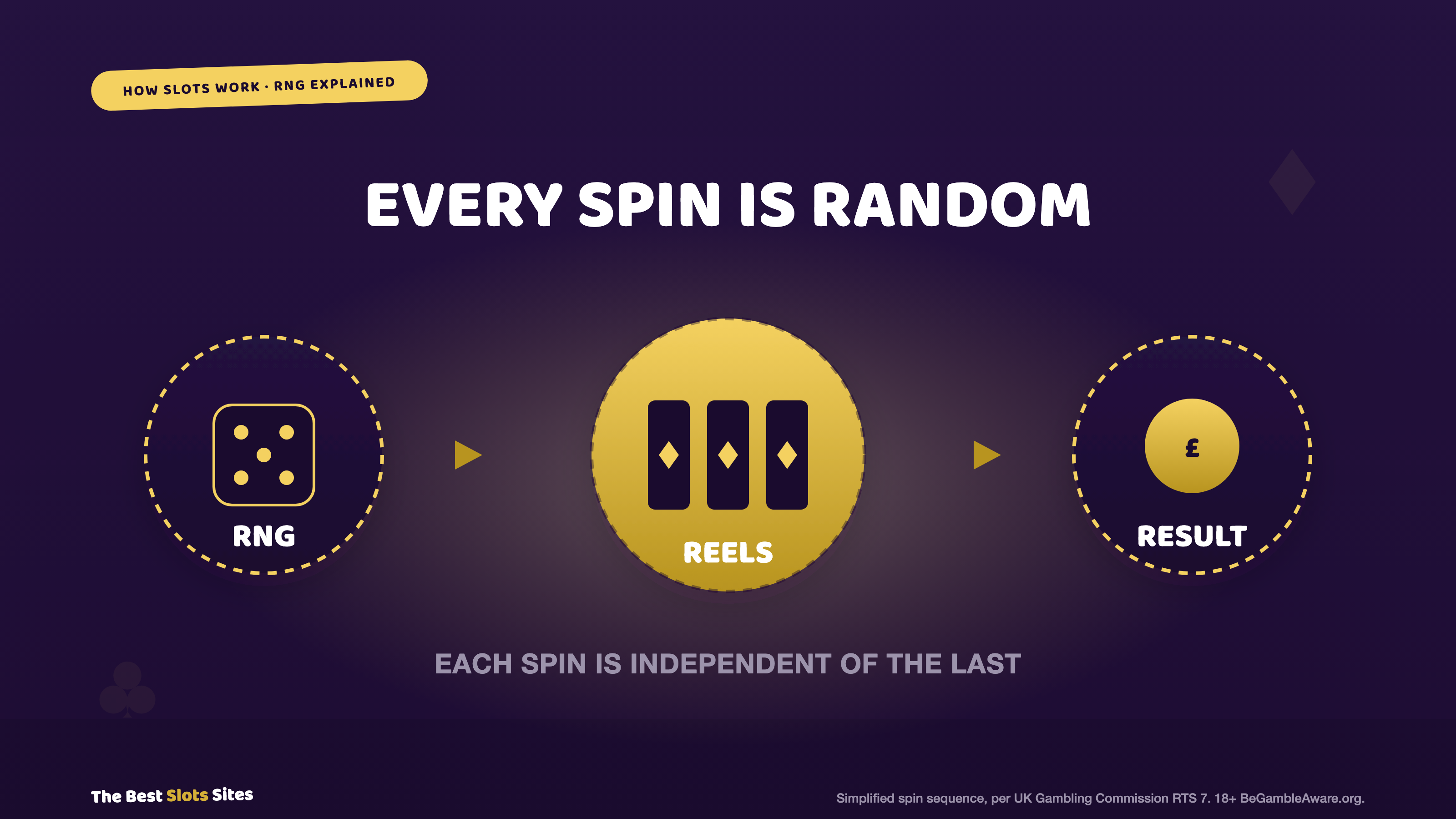
Every spin on a modern online slot comes down to one thing: a random number generator (RNG) picks a single, independent result the instant you hit spin, and everything you see afterwards — the reels landing, the symbols animating into place, any win being paid — is just a display of that already-decided outcome. There's no mechanical reel spinning behind the screen, no machine that's "warming up," and no spin that's influenced by the one before it.
What Happens When You Hit Spin
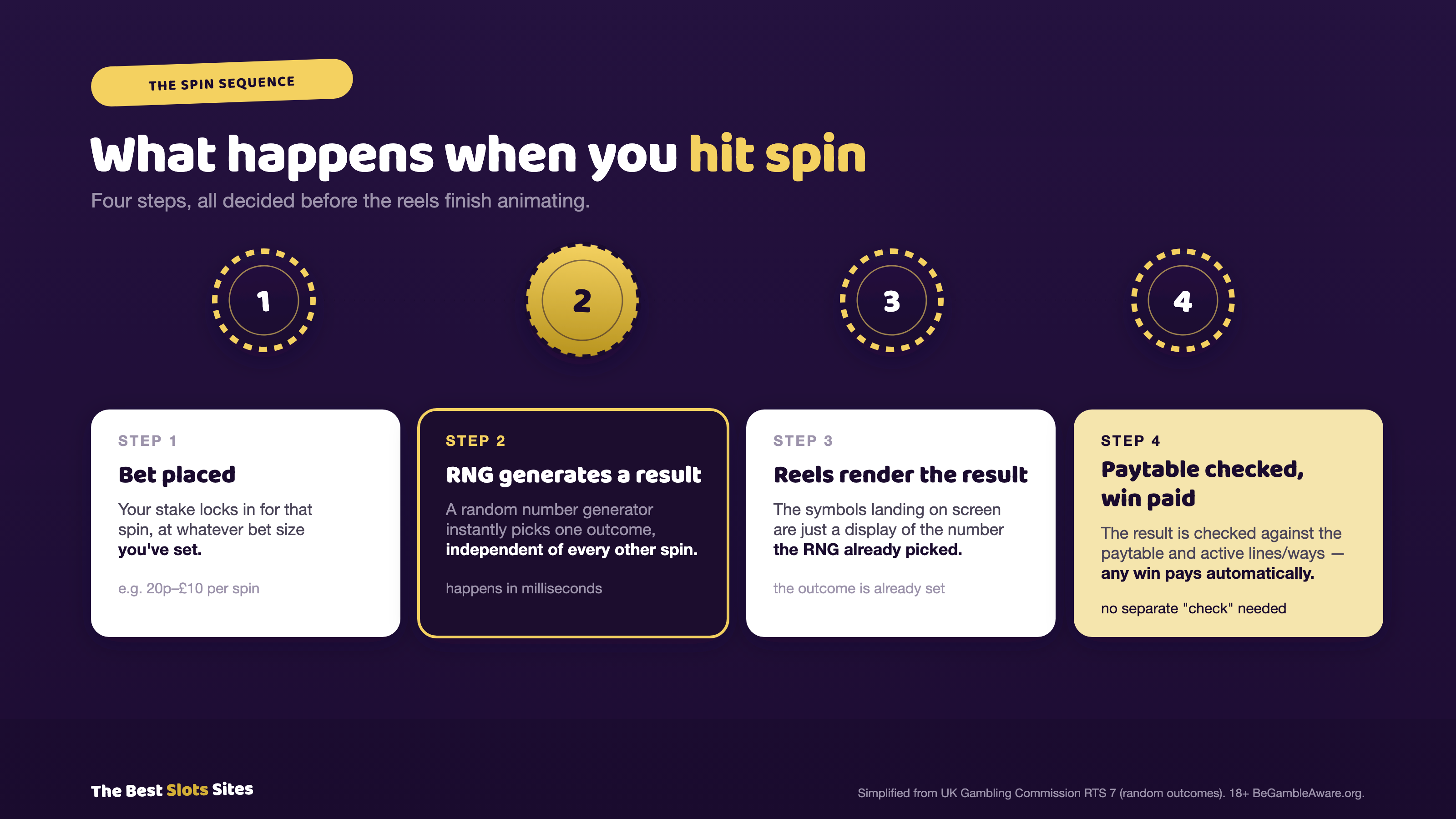
Behind the animation, a slot spin is really four things happening in sequence, all inside a fraction of a second:
- Bet placed. Your stake for that spin locks in at whatever bet size you've set.
- The RNG generates a result. A random number generator instantly picks one outcome from every mathematically possible result the game can produce — independent of any spin before or after it.
- The reels render that result. The symbols animating into place on screen are a visual display of the number the RNG already picked — the outcome isn't decided by watching the reels land, it's decided before the animation even starts.
- The paytable is checked and any win is paid. The game checks the result against its paytable and active paylines, ways or clusters, and pays automatically if it's a winning combination.
This matters because it explains why the reel animation is essentially theatre. Some slots even offer a "quick spin" or "turbo" setting that shortens the animation — the underlying result and its odds are exactly the same either way, because the RNG has already done its job before the reels start moving.
Every Spin Is Independent — There's No Such Thing as a "Due" Machine
Because each spin is a fresh, independent RNG result, a slot has no memory of what happened on the spin before. This is the single most useful thing to understand about how slots work, because it directly rules out some of the most common myths:
- "This machine is hot/cold." A slot isn't warmed up or cooled down by recent results. The RNG doesn't track a session's win or loss history, so a run of losses (or wins) has no bearing on the next spin.
- "It's due a win." There's no counter inside a slot ticking down to a guaranteed payout. Every spin draws from the same odds as the last, regardless of how long it's been since the last win.
- "Playing at a certain time of day changes the odds." The RNG doesn't know or care what time it is. Odds are built into the game's design, not the clock.
None of this means outcomes are unfair — it means they're genuinely random within the odds the game was built with, which is exactly what independent testing (below) exists to verify. It also means there's no pattern, timing or "system" that can predict or influence an RNG-based game's next result — anything sold as a strategy for beating a slot's RNG isn't describing how the game actually works.
Fixed Paylines, Ways to Win, Cluster Pays and Scatter Pays
The RNG is identical in principle across every online slot, but how a game turns that random result into a win differs a lot. Four real examples from slots we've reviewed show the range:
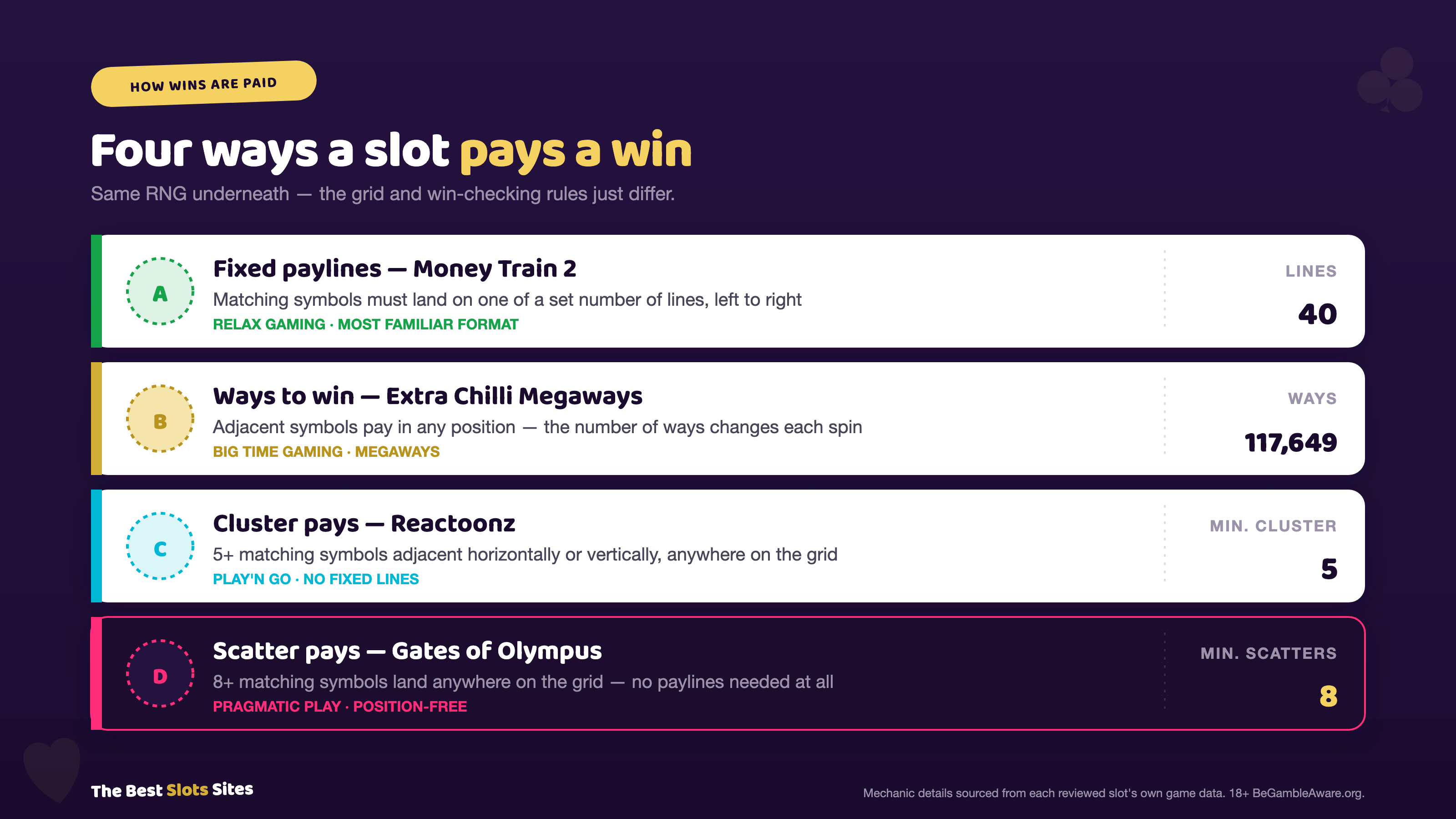
- Fixed paylines — Money Train 2. The classic format: matching symbols have to land on one of a set number of pre-defined lines (Money Train 2 uses 40), usually read left to right across the reels.
- Ways to win / Megaways — Extra Chilli Megaways. Adjacent symbols pay regardless of their exact position on the reel, and the number of "ways" can change every spin as the reels resize — Extra Chilli Megaways can offer up to 117,649 ways on a single spin.
- Cluster pays — Reactoonz. There are no paylines at all; instead, five or more matching symbols connected horizontally or vertically anywhere on the grid form a winning cluster.
- Scatter pays — Gates of Olympus. Also line-free: a set number of matching symbols (eight or more on Gates of Olympus) landing anywhere on the grid pays out, with no adjacency or line requirement at all.
Whichever format a slot uses, it's just the rulebook for translating one RNG result into a win check — the randomness behind it works the same way in every case.
How Fairness Is Tested and Regulated
None of this is left to an operator's word. Under the UK Gambling Commission's remote gambling and software technical standard on random outcomes (RTS 7), the RNG behind any slot offered to UK players has to be demonstrably "acceptably random" — its output must be uniformly distributed across the whole possible range, computationally infeasible to predict even with knowledge of the algorithm, and free of any pattern that lets one spin's result influence another. The standard also explicitly rules out "adaptive" behaviour: a game can't quietly nudge its odds based on a session's history, and every number the RNG produces has to be used in the order it's generated, not selectively discarded.
Before a game goes live, an accredited independent test house checks it against these standards as part of the licensing process — see the Commission's testing strategy for compliance with remote gambling and software technical standards for how that procedure works. A casino operator doesn't get to self-certify a slot's RNG or adjust it after the fact — that's built and verified at the game level, by the studio and an independent test house, before it's ever offered on a UK-licensed site.
Does Bet Size, Autoplay or Time of Day Change Your Odds?
A few related questions come up constantly, and the answer to all of them follows from the same RNG mechanics above:
- Does betting bigger improve your odds of winning? No — bet size scales how much a win pays, not the probability of landing one. The RNG result and the underlying odds are the same at any stake the game allows.
- Does autoplay change anything? No. Autoplay just triggers the same spin sequence automatically instead of you pressing the button each time — each spin it triggers is still an independent RNG result.
- Does playing at a "quiet" time improve odds? No. There's no server-side adjustment based on how many people are playing, what time it is, or how a casino's day has gone so far.
If a claim about beating a slot's odds doesn't hold up against "every spin is an independent RNG result, tested for randomness before launch," it's worth treating with real scepticism.
The Bottom Line
A slot machine's inner workings are simpler than they look: press spin, an RNG picks one independent result, the reels display it, the paytable is checked, and any win pays out. The visual differences between fixed-payline, ways-to-win, cluster-pays and scatter-pays slots are all just different rulebooks sitting on top of that same random result.
Because each spin genuinely doesn't know or care what happened before it, there's no timing, betting pattern or "system" that changes the underlying odds — the only thing that reliably works is deciding your budget before you play and sticking to it. See our responsible gambling policy for tools and support if you'd like help setting limits on your play.