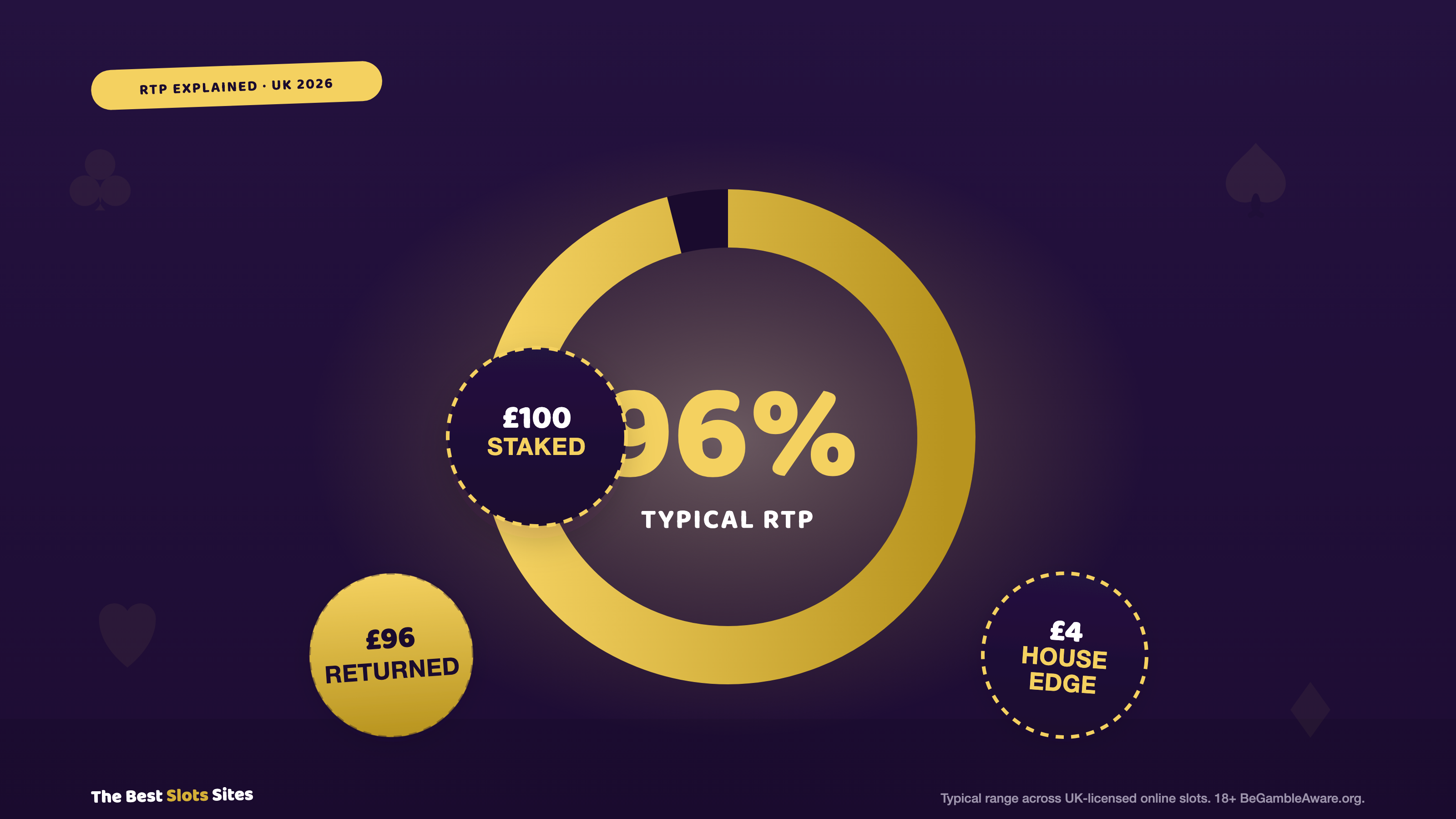
RTP (Return to Player) is the percentage of everything staked on a slot that the game is built to pay back to players over the long run. A slot with a 96% RTP is designed to return £96 for every £100 wagered across millions of spins — the remaining £4 is the casino's built-in edge. It's a theoretical, long-run average rather than a promise about your next session, and every slot on a UK-licensed casino has to make its RTP public.
What Does RTP Mean?
RTP stands for Return to Player. It's expressed as a percentage of total stakes, calculated over a very large number of spins — not your next ten spins, or even your next thousand. If a slot has a 96.5% RTP, the maths says it's designed to pay back £96.50 of every £100 wagered on it over its full lifetime of play across every player who spins it, not just you.
RTP and house edge are two sides of the same number: RTP + house edge = 100%. A 96% RTP slot has a 4% house edge; a 94% RTP slot has a 6% house edge. Lower RTP doesn't mean a slot is "rigged" — it means the built-in edge the operator keeps is larger. Every legally operating UK slot has an edge; the RTP figure just tells you how big it is.
The figure itself isn't decided by the casino you play at. It's built into the game by the studio that developed it (Pragmatic Play, NetEnt, Hacksaw Gaming, and so on) and is the same wherever that exact version of the game is offered, whether that's this site's recommended brands or a competitor's.
How RTP Is Actually Calculated
According to the UK Gambling Commission's own guidance, RTP is worked out with a simple formula once a game has been played enough times to generate reliable data:
Total wins ÷ total turnover (total amount staked) = actual RTP
Before a slot ever reaches players, though, its designers calculate a theoretical RTP mathematically, from the paytable, reel strips and every feature's trigger odds. That theoretical figure, along with the game's volatility, is then checked by an accredited independent test house as part of the licensing process required for any slot offered to UK players — it isn't something the casino gets to self-certify. Only once that testing confirms the simulated RTP lines up with the theoretical figure (within an accepted tolerance) can the game go live.
Theoretical RTP vs What You'll Actually Get
This is the part most explainers skip: the published RTP is a theoretical long-run figure, and how close any real block of play gets to it depends entirely on how many spins are in that sample. The Gambling Commission's own testing standards illustrate this with a tolerance table showing how far a simulated RTP is allowed to drift from the theoretical figure before it fails testing:
- At 50,000 games played, the accepted tolerance is roughly ±4.91% around the theoretical RTP.
- At 1,000,000 games played, that tolerance narrows to roughly ±1.10%.
In plain terms: the more spins that go into the sample, the closer the actual result sits to the published number. A single session of a few hundred spins is nowhere near enough for the "law of large numbers" to kick in, which is exactly why you can easily have a session well above or well below a slot's advertised RTP without anything being wrong with the game. RTP describes millions of spins pooled across every player, not your evening.
What Counts as a Good RTP?
Across the slots we've reviewed on this site, published RTPs range from 95.00% up to 96.82%, which lines up with the wider UK online slots market. As a rough guide:
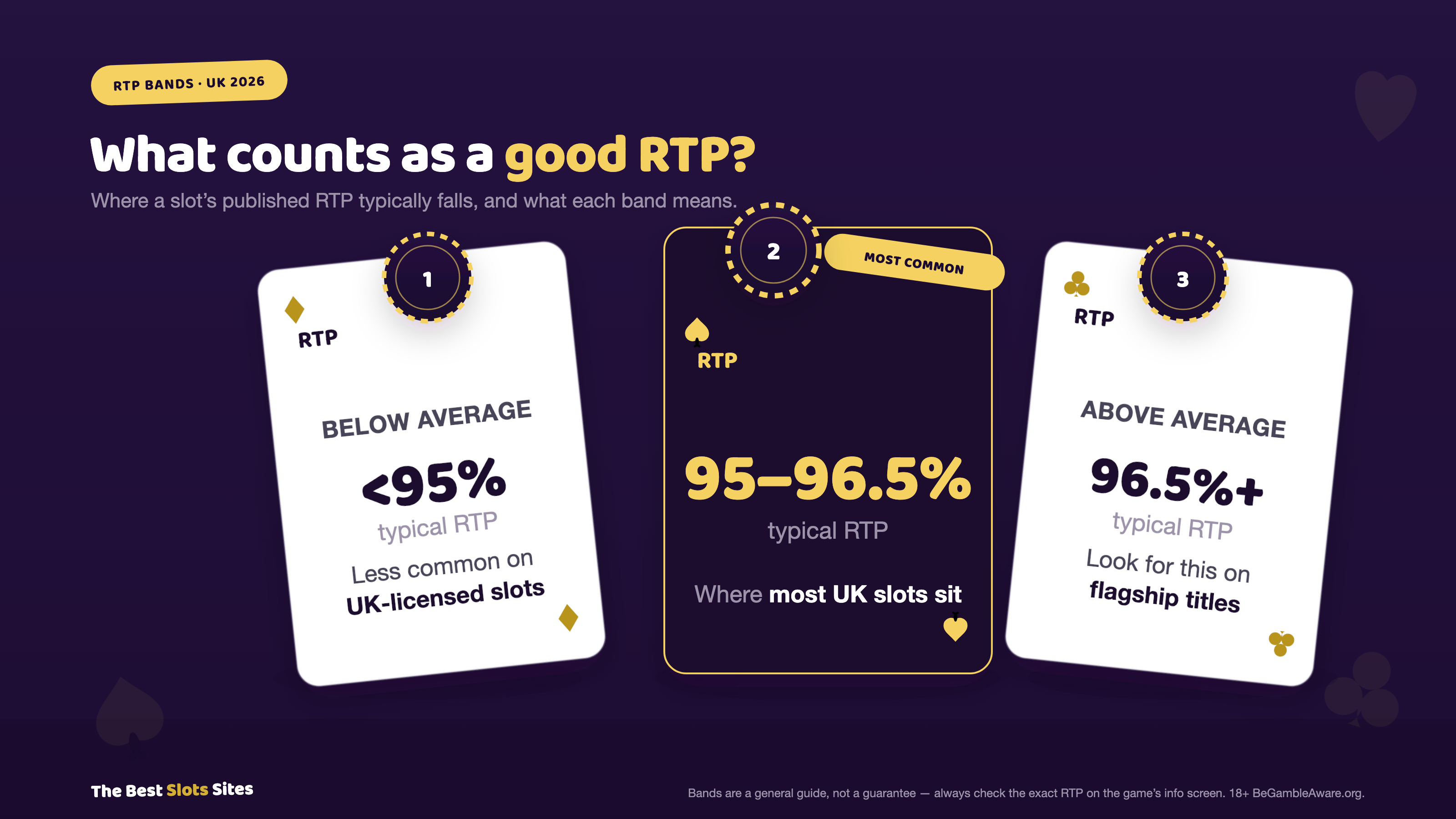
A slot advertising 96.5%+ isn't automatically "better" to play than one at 95.5% — volatility, hit frequency and max win all shape how a session actually feels, which is why we publish RTP alongside those figures in every review rather than as a standalone score.
RTP Across 6 Slots We've Reviewed
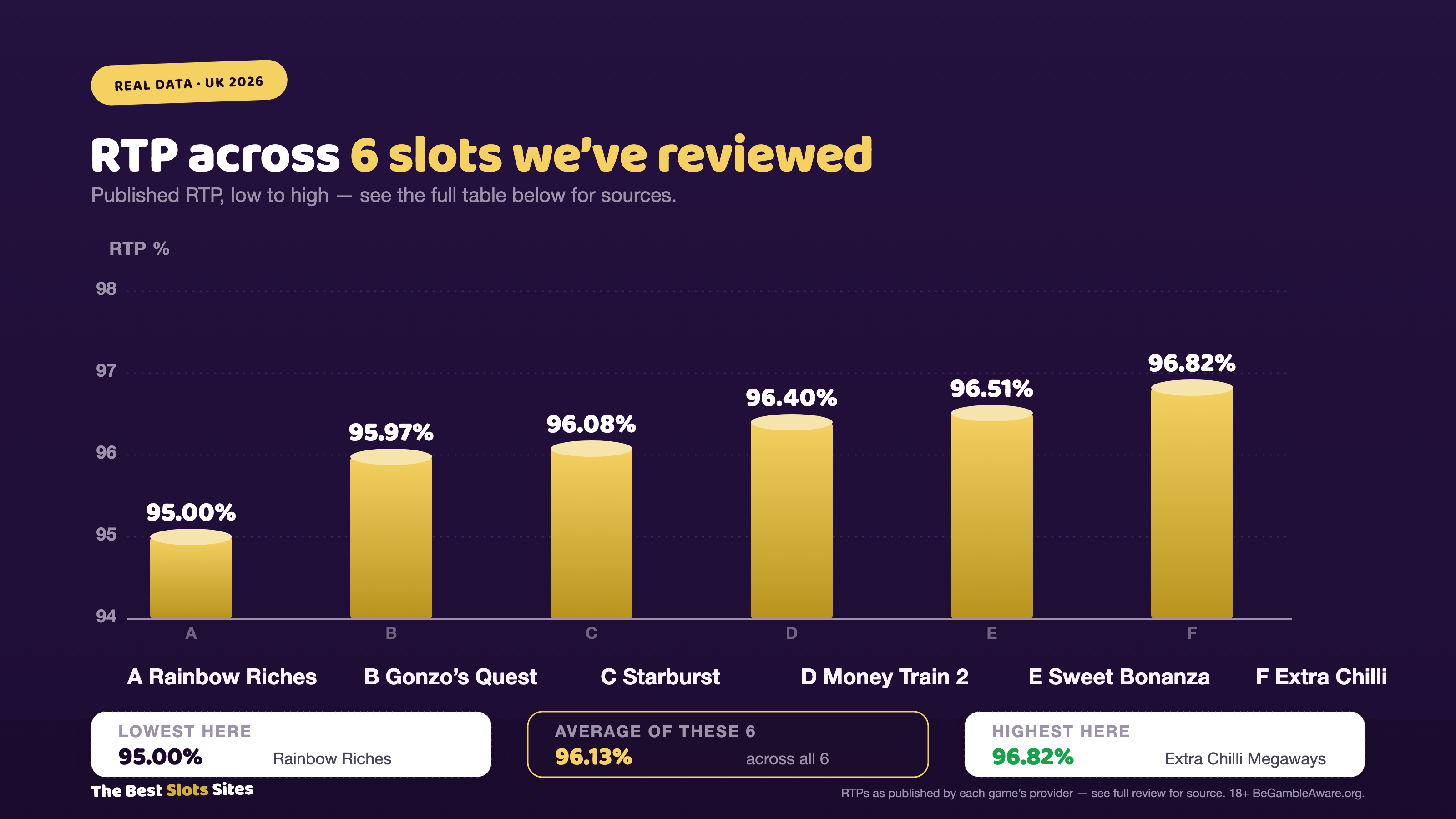
Rather than quoting an industry-wide average we can't verify, here's the published RTP for six slots we've reviewed in full, lowest to highest:
| Slot | Provider | RTP | Volatility |
|---|---|---|---|
| Rainbow Riches | Barcrest | 95.00% | Medium |
| Gonzo's Quest | NetEnt | 95.97% | Medium |
| Starburst | NetEnt | 96.08% | Low |
| Money Train 2 | Relax Gaming | 96.40% | High |
| Sweet Bonanza | Pragmatic Play | 96.51% | High |
| Extra Chilli Megaways | Big Time Gaming | 96.82% | High |
Notice there's no strict pattern linking RTP to volatility — Starburst is low volatility at 96.08% RTP, while Money Train 2 is high volatility at a similar 96.40%. The two numbers describe different things: RTP is about how much comes back over time, volatility is about how it arrives (small, frequent wins versus rarer, bigger ones).
How to Find a Slot's RTP Before You Play
- Check the in-game info screen. Every slot on a UK-licensed casino must display its RTP somewhere in the game's menu or paytable — usually under an "i" or "info" icon.
- Check the provider's official game page. Studios like Pragmatic Play, NetEnt and Hacksaw Gaming publish data sheets listing RTP, volatility, max win and hit frequency for each release.
- Check an independent review. We publish the RTP, volatility, max win and bet range for every slot we review, sourced from the provider's own materials — see our full list of reviewed slots, or our High RTP Slots page for titles rated 96.5% or higher.
One thing worth knowing: some slots are released with more than one RTP configuration (operators can sometimes choose from a provider-approved range, most commonly on games with an optional feature-buy). Where that applies, the in-game info screen for the specific casino you're playing at will show which configuration is live, which is the only fully reliable source for that exact session.
RTP Isn't the Whole Picture
RTP is a useful, regulated, comparable number — but it's a long-run average, not a forecast, and it says nothing about how big or how frequent individual wins are likely to be. Two slots with an identical 96.5% RTP can feel completely different to play depending on their volatility and max win potential. If you're comparing slots to try, it's worth reading a full review rather than RTP alone — our online slots hub covers RTP, volatility and win potential together for every game.
Whatever the RTP, remember it describes millions of pooled spins, not a guaranteed outcome for any individual session — play within a budget you've set in advance, and see our responsible gambling policy for tools and support if you ever want to set limits on your play.