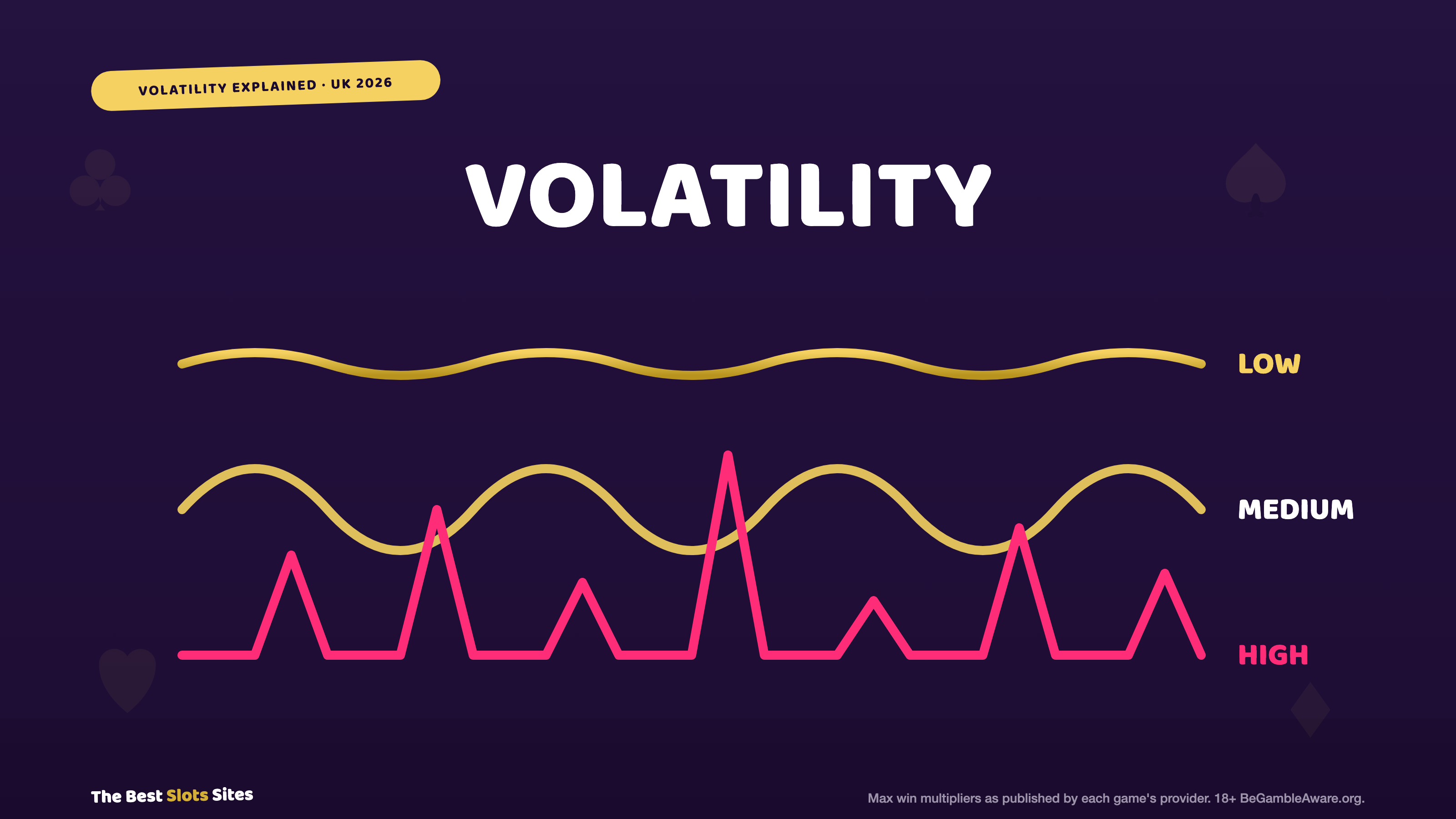
Volatility (sometimes called variance) describes the size and spread of a slot's wins, not how often you win. A low volatility slot pays smaller amounts more regularly; a high volatility slot pays less often on average but can produce much bigger wins when it does. It's a separate stat from RTP — two slots can share the same RTP and still feel completely different session to session because of volatility.
What Is Volatility in Slots?
Volatility (or variance) is a measure of risk built into a slot's math model — it describes how a game's payouts are distributed across its paytable and features, not how much it pays back overall. That's RTP's job. Volatility is about shape: does the game pay in a steady trickle of small wins, or does it hold back for long stretches and then release a much bigger win when a feature lands?
Providers usually publish a volatility rating — low, medium or high, sometimes with a numeric scale (1–5 or 1–10) alongside it — based on their own simulations run across millions of spins. It's a design choice baked into the reel strips, paytable and bonus trigger odds before the game ever goes live, the same way RTP is, and it's independently tested as part of UK licensing.
Two figures on a slot's stats sheet do most of the work in describing that shape: hit frequency (how often any win lands, of any size) and maximum win multiplier (the biggest possible win relative to stake). It's tempting to assume those two move together — that a slot landing wins less often must be saving them up to pay bigger — but as the data below shows, that assumption doesn't hold up once you look at real published figures across slots we've reviewed.
None of this is fixed for the life of a game either. A provider builds one volatility profile into a title and it stays that way across every casino offering it, in the same way RTP does — it isn't something an individual operator can dial up or down.
RTP and volatility are worth reading together rather than in isolation, and our RTP explained guide covers the other half of that pairing in full.
High Volatility vs Low Volatility
In practice, the two ends of the scale play very differently:
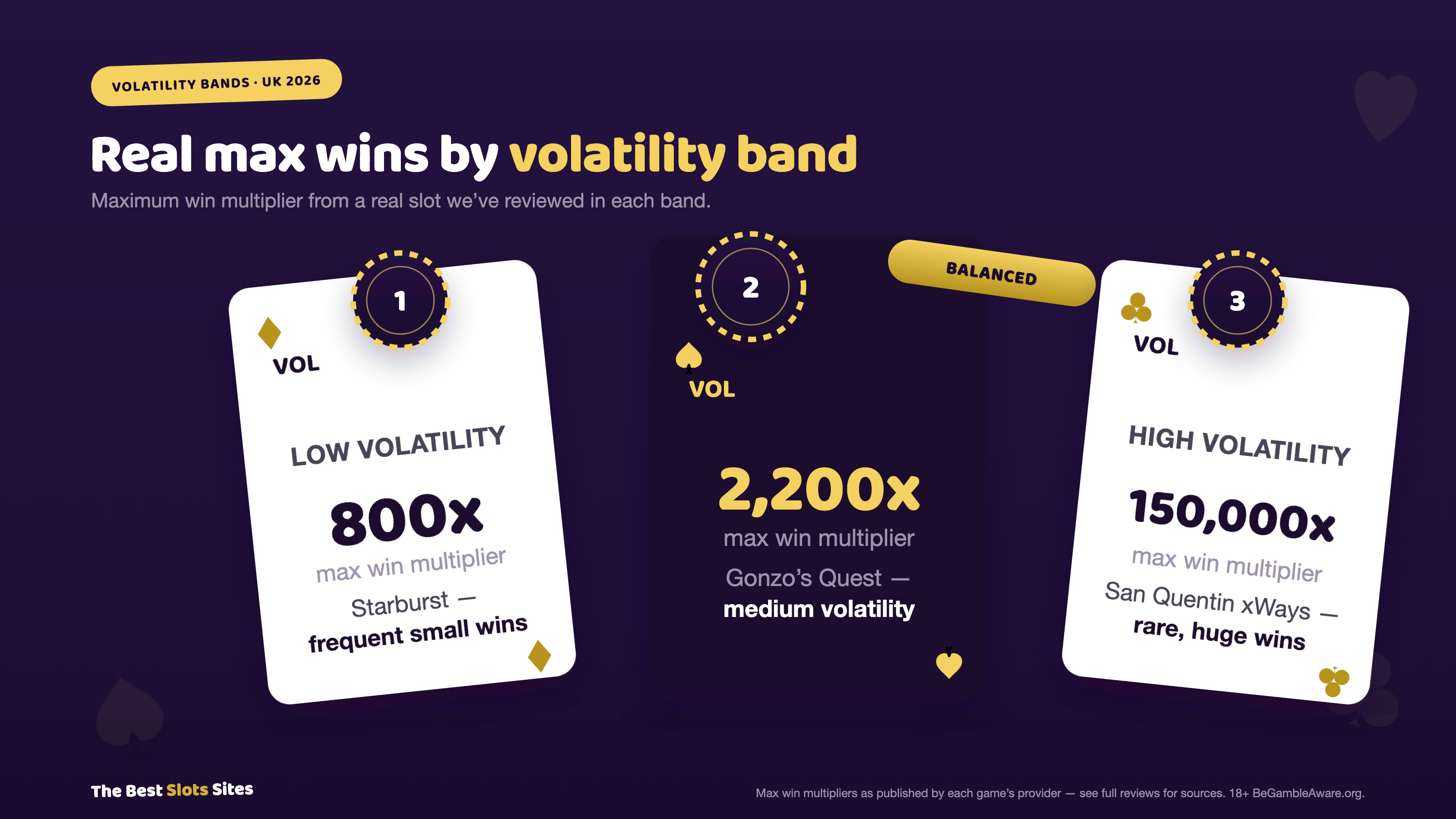
Low volatility slots, like Starburst, pay smaller wins more often and rarely swing far from the game's RTP over a shorter session — there's less peak upside, but also fewer long dry spells. Medium volatility slots, like Gonzo's Quest, sit in between: a mix of regular smaller wins and occasional bigger ones from its Avalanche feature. High volatility slots hold back more often in exchange for a much higher ceiling — when a feature does trigger, the win can be dramatically larger relative to stake, but the game can go through longer stretches between meaningful wins to fund that potential.
Why Hit Frequency Doesn't Predict Volatility
Hit frequency is the percentage of spins that land any win at all, however small. It sounds like it should track volatility closely — more frequent wins should mean lower volatility, right? Real published data from slots we've reviewed shows that's not reliably true:
| Slot | Volatility | Hit frequency | Max win |
|---|---|---|---|
| Starburst | Low | 23% | 800x |
| Gonzo's Quest | Medium | 41% | 2,200x |
| Spice | High | 19.6% | 15,000x |
| Money Train 4 | High | 20.1% | 150,000x |
| Fire in the Hole 2 | High | 25.1% | 65,000x |
| San Quentin xWays | High | 34.3% | 150,000x |
| Sweet Bonanza 1000 | High | 42.9% | 25,000x |
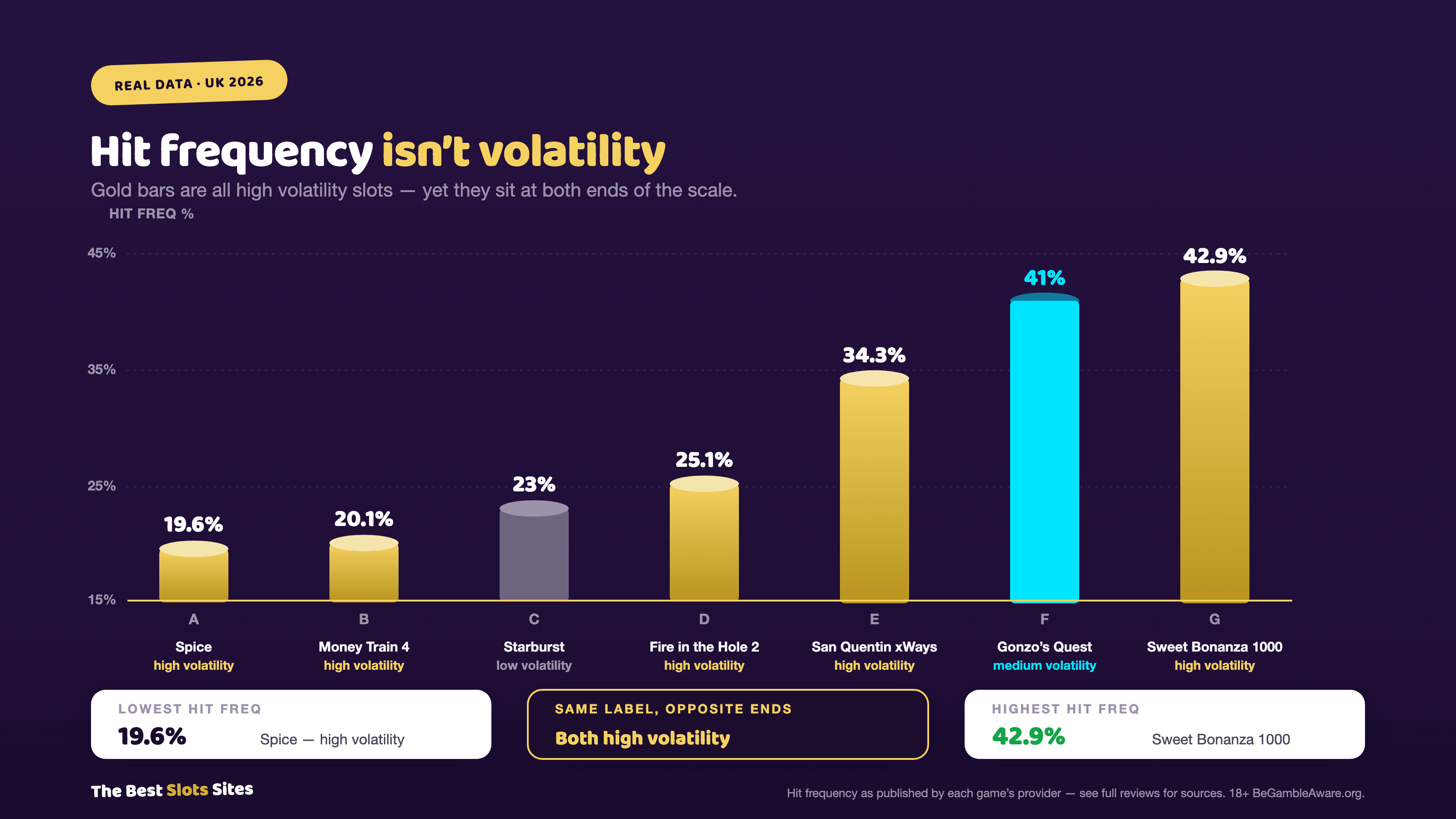
Spice, rated high volatility, has a lower hit frequency (19.6%) than Starburst, rated low volatility (23%) — the opposite of what you'd expect if hit frequency alone decided the rating. At the other end, Sweet Bonanza 1000 is also high volatility but has the highest hit frequency of this whole group at 42.9%, even ahead of the medium-volatility Gonzo's Quest (41%). Two slots can land a win on roughly four spins in ten and still sit at opposite ends of the volatility scale, because volatility is about the size and spread of those wins — not how often any win, however small, shows up. Sweet Bonanza 1000's frequent wins are mostly small scatter pays that fund the occasional much larger tumble sequence; Spice's rarer wins lean more heavily on its bonus features to deliver size.
Max Win Potential: The Clearest Signal
If hit frequency is unreliable, the maximum win multiplier a provider publishes is the clearest practical signal of what a slot's volatility actually means for you. Starburst, low volatility, caps out at 800x your stake. Compare that with high volatility titles like Money Train 2 (50,000x) or San Quentin xWays and Money Train 4, both capable of 150,000x — nearly 200 times higher a ceiling than Starburst, for the same size stake. That gap is the practical trade-off volatility describes: a low volatility game gives you a much narrower, steadier range of outcomes, while a high volatility game gives you a much wider one, with most sessions landing well short of that headline number and a small share landing far above what a low volatility game could ever pay on the same spin.
Choosing a Volatility Level That Suits You
There's no volatility level that's objectively "better" — it's a matter of what kind of session you'd rather have, set against a budget you've decided in advance:
- Prefer smaller, steadier outcomes? Low volatility slots like Starburst are built to keep your balance moving without the swings.
- Want a shot at a much bigger multiplier and can accept a bumpier ride to get there? High volatility slots like the ones in the table above trade frequency for ceiling.
- Not sure yet? Medium volatility slots like Gonzo's Quest are a reasonable middle ground while you work out which style of session you prefer.
Checking a slot's volatility rating, hit frequency and max win together — which every review on this site publishes — gives a far more complete picture than any one figure alone.
Volatility Isn't a Warning Sign
Volatility is a design choice, not a fault — a high volatility slot going through a long run without a big win is exactly how that game is built to behave, not a sign it's "due" a payout or that chasing losses will fix a losing run. If a session isn't going the way you expected, that's the normal shape of variance at work, not a signal to stake more to compensate. Set a budget before you play and stick to it regardless of the volatility you choose — see our responsible gambling policy for tools and support if you'd like help setting limits.