Megaways is a slot mechanic where the number of symbols showing on each reel changes on every single spin, so the total number of ways to line up a win changes with it — sometimes into the hundreds of thousands. Instead of a fixed set of paylines that never move, a Megaways reel set can be tall on one spin and short on the next, and the game recalculates how many "ways to win" are live each time.
What Is Megaways?
On a standard slot, every reel shows the same number of symbol positions on every spin — typically three rows across five reels, giving a fixed number of paylines (20, 25, 40, and so on) that never changes. Megaways throws that out. Each of the (usually six) reels can independently display anywhere from two to seven symbols on any given spin, decided randomly each time the reels stop.
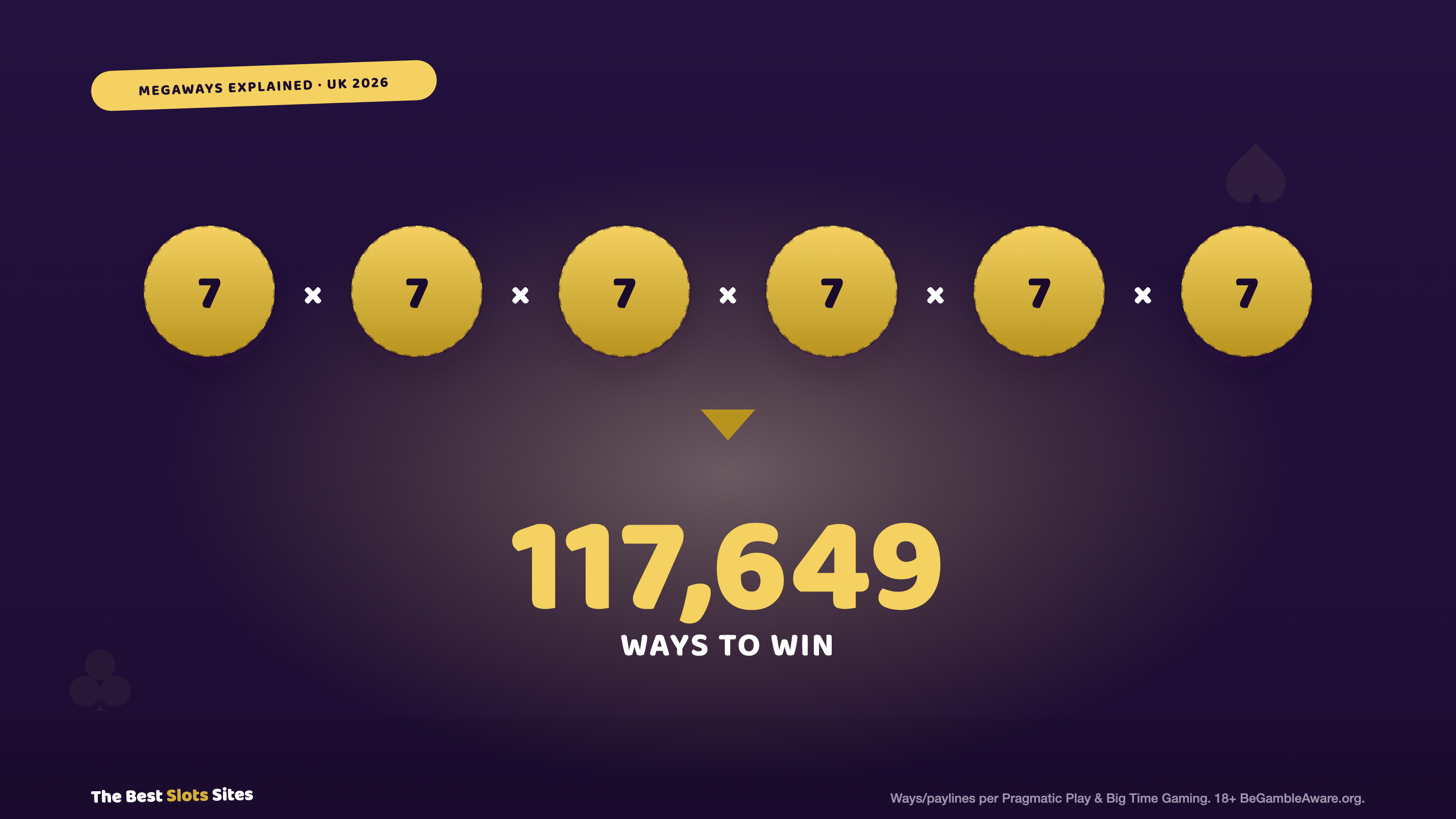
Because the reel heights are different on every spin, the number of possible left-to-right symbol combinations — the "ways to win" — is different too. A short spin with only two symbols on most reels might offer a few hundred ways. A tall spin with seven symbols showing on every reel can push the total past 100,000. That constantly shifting ceiling, often advertised as "up to" a specific number, is the entire identity of the mechanic.
Who Invented Megaways?
Big Time Gaming (BTG) created the Megaways mechanic and holds a patent and trademark on it. BTG licenses Megaways out to other studios for a fee rather than keeping it exclusive to its own titles, which is why you'll see the Megaways name on games built by Pragmatic Play, Blueprint Gaming, Red Tiger, iSoftBet and several others — each of those studios has paid BTG for the right to use the trademarked mechanic in their own games. BTG itself was acquired by Evolution in 2021, which brought the Megaways patent into the Evolution group along with it.
That licensing structure matters for one practical reason: "Megaways" specifically refers to BTG's patented system. Other studios have built their own similarly variable-reel mechanics under different names (more on that below) — they aren't Megaways, even though they achieve a comparable effect.
What "Ways to Win" Actually Means
"200,704 ways to win" sounds like 200,704 individual paylines, but it isn't — nobody designs that many literal lines. A "way to win" is simply every possible combination of matching symbols that are adjacent, left to right, starting from reel one. If reel one shows 4 symbols, reel two shows 6, reel three shows 5, and so on, the ways-to-win total is the product of however many symbols are showing on each of the reels involved in a match — multiply enough tall reels together and the number balloons fast, which is exactly how six variable reels get to six-figure totals.
You don't need to calculate any of this yourself. The game works out the live ways-to-win total for the current spin and typically displays it on screen, and the "up to" figure quoted in a review or on the paytable is simply the maximum possible total when every reel lands at its tallest.
Megaways Titles We've Reviewed
Here's how the ways-to-win totals actually differ between Megaways games, using two titles we've reviewed in full:

| Slot | Provider | Max ways to win | Reel layout |
|---|---|---|---|
| Buffalo King Megaways | Pragmatic Play | 200,704 | 6 reels, 2–7 rows |
| The Dog House Megaways | Pragmatic Play | 117,649 | 6 reels, 2–7 rows |
Notice both games max out at exactly the ways-to-win figure you'd get from six reels each capable of showing up to seven symbols (76 = 117,649) — Buffalo King Megaways goes further because one of its reels can hold up to eight positions on its top spin, pushing the ceiling higher still. It's also common to see Megaways paired with cascading (or "tumbling") wins, where winning symbols disappear and new ones drop in to potentially chain further wins from the same spin without staking again — both of the titles above use the mechanic alongside sticky wilds and free spins rather than on its own.
Fixed Paylines vs Megaways: A Real Example
The scale jump only really lands when you put a fixed-payline game next to a Megaways one. Wolf Gold, one of the most popular slots on the market, runs on a classic 25 fixed paylines that never change, spin to spin. Buffalo King Megaways, built on the same three-row-by-five-reel footprint in spirit, can offer up to 200,704 ways — over 8,000 times more ways for symbols to line up on any given spin.
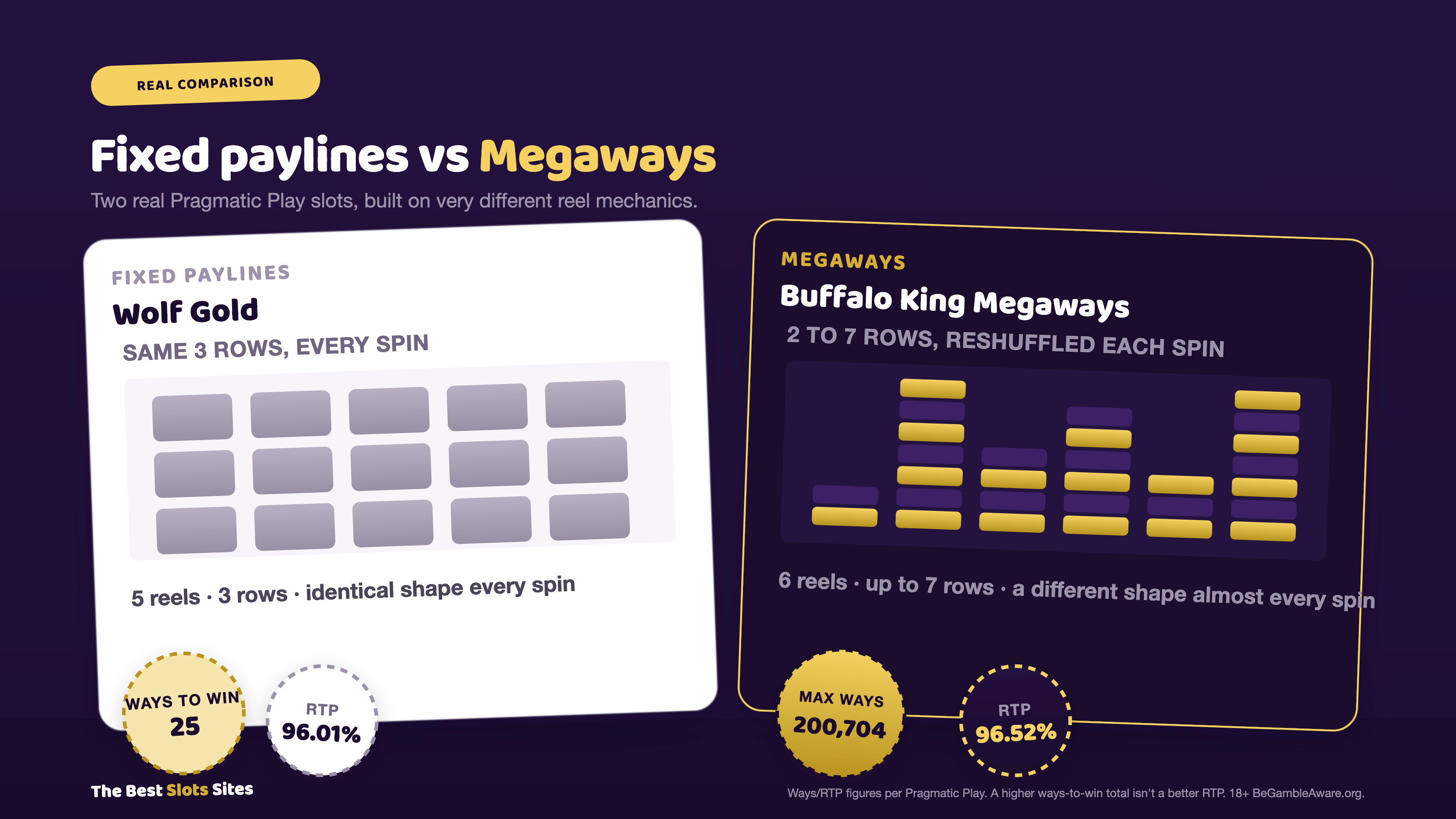
That doesn't make one mechanic objectively "better" than the other — it changes how a spin feels. A fixed-payline game is predictable: the same 25 lines are always live, and you know exactly what you're betting on. A Megaways game is more volatile in feel: most spins land somewhere in the middle of the range, with the eye-catching maximum only showing up on the rare tallest-possible spin.
Megaways Isn't the Only Variable-Reel Mechanic
Megaways is the best-known variable-reel system, but it isn't the only one on the market — and not every game with a shifting ways-to-win total is actually running BTG's licensed mechanic. San Quentin xWays from Nolimit City is a good example: it starts on 243 fixed ways and expands through the studio's own xWays system (paired with Enhancer Cells) up to a claimed total in the billions. xWays is Nolimit City's proprietary mechanic, built and owned independently of BTG's Megaways patent — it produces a broadly similar "reels that resize and change the ways-to-win total" effect, but under a different name, a different studio, and different underlying rules.
If you see "ways to win" fluctuate on a slot, it's worth checking the paytable or info screen for which specific mechanic is doing it — Megaways, xWays, or one of the other variable-reel systems now on the market — since the exact mechanics (how reels expand, whether there's a cap, what triggers a change) can differ between them.
Does More Ways to Win Mean Better Odds?
No — a bigger ways-to-win number changes how many ways symbols can combine, not the underlying return to player. RTP and house edge are set independently of the ways-to-win total; a Megaways game with 200,704 ways can carry a lower, higher, or identical RTP to a 25-payline game, and the only way to know is to check that specific slot's published RTP, not assume a huge ways figure means better value. See our RTP explained guide for how that figure works.
Want to see the mechanic in action? Browse our Megaways slot reviews for the full list of titles we've covered, each with its own RTP, volatility, and max win figures.
A large "ways to win" number is easy to read as a sign a game is more generous — it isn't, on its own. If you're trying a Megaways title, it's worth reading the full review for its RTP, volatility and max win before assuming the biggest number on the paytable tells you anything about your odds, and playing within a budget you've set in advance. See our responsible gambling policy for tools and support if you ever want to set limits on your play.